

For years, the relationship with hair was complicated. I blasted it with heat, ripped through tangles, and wondered why it looked like straw. Turns out, hair was not the problem — habits were. The difference was never one miracle product; it was ten small habits, repeated until they ran on autopilot. This guide shows not just what to do, but how to turn each habit into something you actually keep.
1. Wash According to Your Hair, Not the Calendar
The old habit: washing hair every single day because that is just what you did — until a hairstylist friend asked why, and there was no answer. My scalp was oily by noon anyway; daily washing was making it worse. The habit to build is listening instead of scheduling: wash when your hair actually needs it, which for most people is two or three times a week. To make it stick, pick fixed wash days for two weeks and note how your scalp feels on day two and three — that note is your real schedule, far better than any rule. If oil arrives fast, the fix usually isn’t more washing; it is washing smarter, shampooing the scalp rather than the lengths, with comfortable water, never scalding.

2. Actually Condition (Your Ends Are Begging)
Confession: I used to rush conditioner. Slap it on, rinse immediately, wonder why my ends still felt like straw. Conditioning only works as a habit if it gets time — two or three unhurried minutes, every single wash, focused on the mid-lengths and ends where hair is oldest and driest. Make it automatic by tying it to a cue you never skip: shampoo first, then conditioner, then everything else in the shower, so it always gets its minutes. Track it the easy way: once a month, run your fingers through your ends and check for snagging. When they stop catching, the habit is paying off — and that small, visible win is what keeps you doing it month after month. That monthly check is the habit’s progress report.

3. Detangle Like You Mean It (Gently)
Most breakage I blamed on “weak hair” was really me ripping a brush through wet tangles. The habit that fixed it: detangle before washing, not after, when hair is dry and strongest, working from the ends upward in short, patient strokes. Keep the tool in one visible place — a wide-tooth comb by the mirror — because a habit you have to hunt for is a habit you skip. Count the hairs in the comb for the first week; when that number drops, you have proof the gentle approach works, and proof is a better motivator than any lecture. Wet hair can wait for a wide-tooth comb and a light hand, never a fine brush and a hurry.
As an Amazon Associate, The Beauty Glow Edit earns from qualifying purchases.
Product pick: Wide-Tooth Detangling Comb

4. Give the Heat Tools a Break (Sometimes)
Nobody is giving up heat styling forever, and this habit doesn’t ask you to. It asks for planned heat-free days — two a week to start — instead of heat by default. The trick is planning the night before: on heat-free evenings, braid damp hair loosely or twist it into a low bun so morning hair already has shape without a tool. Put the heat-free days on the same days each week so they become routine rather than a daily negotiation. After a month, check the ends: fewer splits and less frizz at the same length is the habit working. Heat stays in your life; it just stops being the only way your hair ever looks good. Put the two days on your calendar.

5. Protect Your Hair While You Sleep
Night is the riskiest time for hair and the easiest habit to build, because it takes thirty seconds. Hours of friction against a cotton pillowcase plus tension from tight styles snap strands while you sleep — so the nightly habit is simple: hair dry, style loose, surface smooth. Swap the tight bun for a loose braid or low bun with a soft scrunchie, and sleep on satin or silk so hair glides instead of catching. Tie it to something you already do every night, like skincare, so it never gets forgotten. Morning check: fewer broken hairs on the pillow and less frizz to fight means the habit is already paying for itself.
Product pick: Satin Sleep Bonnet
For a full wind-down that pairs with this one, see our night beauty rituals.

6. Loosen Up Those Tight Hairstyles
Tight ponytails and buns every day pull at the same hairline until it thins — and the damage is slow enough that you don’t notice until it shows. The habit here is a daily tension check: if a style hurts, pulls, or leaves a dent when you take it down, it is too tight, full stop. Rotate styles so no single spot takes the strain two days running, and give your hair at least two loose days a week. Keep a soft scrunchie in your bag as the cue — when you reach for a hair tie, reach for the gentle one. After a few weeks, the hairline feels less tender and baby hairs stop breaking off at the front, which is exactly the result to watch for.
Pair looser styles with easy shapes from our easy everyday hairstyles — polished looks that never need pulling tight.

7. Buy for Your Hair, Not the Trend
My shelf once held twelve half-used bottles, each bought because someone online loved it. The habit that saves money and hair: one-in, one-out. No new bottle until the old one is finished, and every purchase has to answer one question — what does hair actually need right now? Keep a tiny note on your phone: hair type, what worked, what didn’t. That note kills impulse buys better than willpower ever will. When a product runs out, check the note before the shop, not the trending page. Three months of this habit leaves you with a short shelf, products you actually finish, and hair that finally gets a consistent routine instead of a new experiment every week. A short shelf makes mornings faster too.

8. Keep Scalp Care Simple
A healthy scalp grows healthy hair, but scalp care got overcomplicated somewhere along the way. The habit is small and weekly: once a week, spend two minutes massaging your scalp with your fingertips while shampooing — no special tools, no ten-step routine. That massage boosts circulation, loosens buildup, and gives you a weekly check-in: tenderness, flakes, or unusual oiliness all show up here first, before they become hair problems. If something feels off for two weeks running, that is your cue to simplify further or ask a professional, not to buy another treatment. Simple, weekly, noticed — that is the whole habit, and it is the one most people skip while chasing fancier fixes that cost more and do less. Two minutes weekly is the smallest habit here.

9. Stop the Friction Madness
Friction is the quiet hair-wrecker: rough towels, cotton pillowcases, tight elastics, and constant touching all rough up the cuticle until shine disappears. The habit is swapping one friction source at a time, not all at once — start with the towel, since it touches your hair every wash. Pat or wrap hair in a soft microfibre towel instead of rubbing it dry, and give that swap two weeks before judging it. Next swap: the pillowcase. Then the hair ties. One swap per fortnight turns into a low-friction routine without any big effort, and the monthly check is simple: hair that feels smoother when you run a hand down it, and less frizz on humid days, tells you the swaps are working. Smoothness you can feel is the proof.

10. Stay Consistent (Boring but True)
Here is the unglamorous truth behind every good hair transformation: the best routine is the one you actually do. Habits fail when they depend on motivation, and they stick when they depend on order and tracking. Pick a tracking method so simple you cannot avoid it — tick each habit on your phone calendar, or keep a one-line nightly note. The rule that saves every streak: never miss twice. One skipped night is life; two in a row is a new habit of skipping. Judge the whole system after twelve weeks, not twelve days — hair grows slowly, and the people with the best hair are usually just the ones who kept the boring habits longest. Consistency is the habit that makes all the others work.
For the full step-by-step version of the routine itself, see our simple hair care routine.
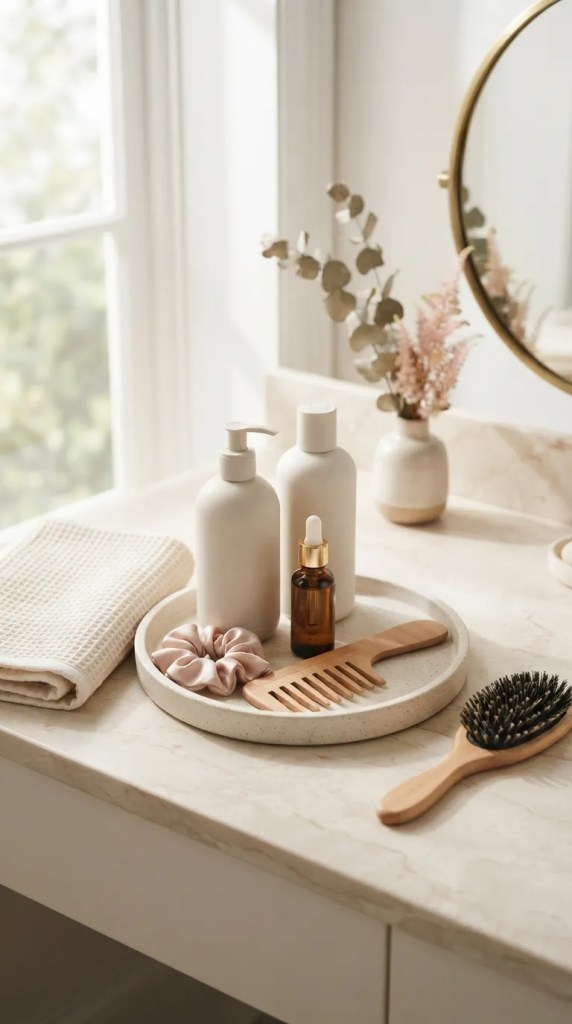
11. Your First 4-Week Habit Plan
Knowing ten habits is useless without a start date, so here is the rollout. Week one: fix washing and conditioning only — fixed wash days, conditioner with its full minutes, nothing else. Week two: add gentle detangling and the sleep habit, since both take under a minute. Week three: add two heat-free days and looser styles. Week four: add the scalp massage, the towel swap, and the one-in-one-out buying rule. One habit at a time beats ten at once because each gets a chance to become automatic before the next arrives. By week four you are doing all ten without thinking hard about any of them — and that is the whole point of a plan. If a week slips, just repeat it instead of quitting.
12. Monthly Hair Check: What to Look For
Habits need a review, or they drift. Once a month, same day, check four things in the mirror: ends (splitting or smooth?), shine (dull or catching light?), breakage (hairs on the pillow and in the comb — more or fewer?), and scalp (calm or flaky?). Write one line per check in your phone note. Two good months in a row means the plan is working — keep it. One bad check means adjust one habit, not all ten: more conditioning if ends are dry, looser styles if the hairline feels tender, an extra heat-free day if frizz climbs. This monthly minute is what turns a list of habits into a system that improves year after year instead of restarting every January. One line a month beats a perfect journal.
Frequently Asked Questions
Q: How long until hair habits show results?
A: Shine and softness often improve within two to four weeks; breakage and growth changes take two to three months, since hair grows slowly. Track monthly, not daily.
Q: Which habit matters most for softer hair?
A: Conditioning with its full minutes, every wash, plus gentle detangling. Those two alone fix most roughness, and they cost nothing extra.
Q: Do I need expensive products for healthy hair habits?
A: No. A gentle shampoo, one good conditioner, a wide-tooth comb, and a satin sleep surface cover nearly everything in this guide.
Q: What if I keep forgetting a habit?
A: Tie it to a cue you never skip — conditioner right after shampoo, sleep protection right after skincare — and use the never-miss-twice rule instead of guilt.
Final Thoughts
Softer, shinier hair was never about finding one perfect product. It was ten small habits, started one at a time, tracked loosely, and kept long enough to work. Start this week with washing and conditioning, add the rest over four weeks, and check in monthly. Your hair will not transform overnight — but in three months, you will run your fingers through it and feel the difference. That is what habits do.
[…] Also read more: Healthy Hair Habits […]